
Many employers are looking for ways to let their employees keep more net value from their bonus and end-of-year premium, without increasing employer costs. Warrants have long been an attractive option. But within a cafeteria plan, you truly unlock their full potential by combining warrants with other tax-efficient benefits.
In this article, we explain why warrants are an interesting option, how they work within a flexible reward plan, and why they bring real added value to SMEs as well.
What exactly are warrants?
A warrant is a financial instrument that grants an employee the right to buy shares and sell them almost immediately. As a result, the employee runs virtually no market risk and quickly receives an optimized net payout in their bank account, without needing to actively follow the stock market.
How does the tax treatment work?
- warrants are taxed at the time of grant
- they are exempt from standard social security contributions (both employer and employee contributions)
- professional withholding tax is deducted as a one-off payment
Why choose warrants?
The primary reason is simple: a significantly higher net impact compared to a traditional cash bonus.
Quick example: from a traditional cash bonus of €1,000 gross, an employee often keeps only around €400 net after social security and withholding tax. Because warrants are exempt from standard social security contributions, the employee retains noticeably more net value.
Why warrants are even more compelling in a cafeteria plan
If you only offer a stand-alone warrant plan, employees are faced with an all-or-nothing choice: participate or not.
In a cafeteria plan, you combine the exact same tax efficiency with maximum choice:
- No all-or-nothing dilemma: employees decide for themselves how much of their budget to allocate to warrants.
- Combine with other needs: an employee can first allocate budget to concrete, tangible benefits and convert the remaining balance into warrants.
- Personal tailoring: what is attractive to one employee (e.g., IT equipment or a bike) often differs from the needs of another colleague (e.g., warrants or extra time off).
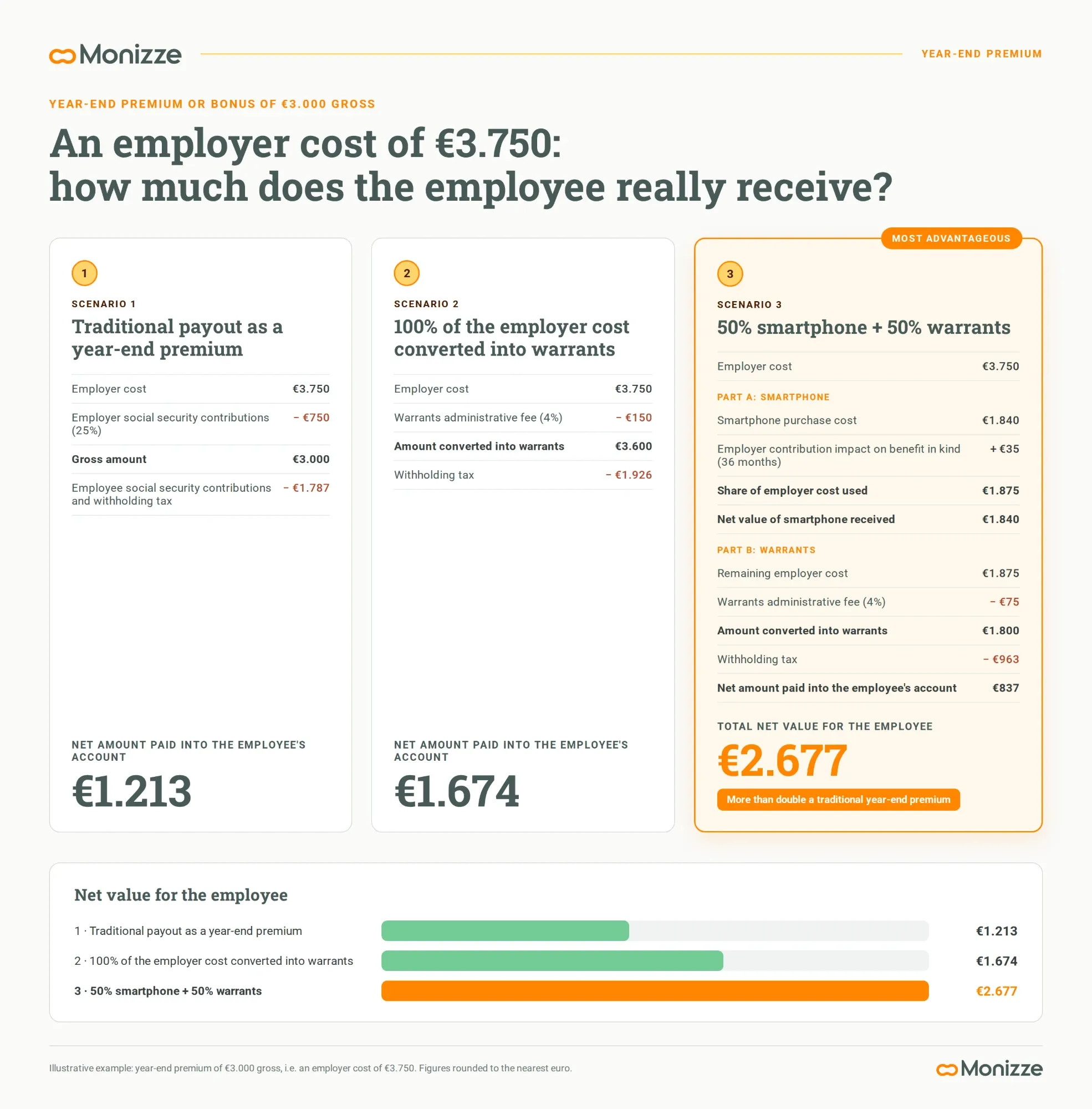
A practical example: suppose an employee has a flexible budget of €3,750 available via a year-end premium. With a traditional cash payout, just €1,213 net remains after social security and withholding tax. If the entire amount is converted into warrants, that net payout rises to €1,674 in their bank account.
Within a cafeteria plan, you can truly maximize that same budget by combining benefits: for example, the employee first selects a new smartphone worth €1,840 and converts the remaining balance into warrants, generating €837 net in cash. This way, the employee combines a tangible benefit with an optimized cash payout, achieving a total of €2,677 in real net value, more than double a traditional bonus.
At the same time, you strengthen your employer brand by offering a modern, tax-efficient compensation policy.
What are the risks and key considerations of warrants?
Warrants offer attractive tax benefits, but they remain a financial instrument. Transparent communication with employees ensures clear expectations:
- limited market risk: warrants are linked to the stock market and are not guaranteed savings. Between the moment of grant and the final sale (usually within a few days), the value may rise or fall slightly. Important: withholding tax is calculated on the value at grant
- selection is final after closing: during the open window, employees can freely adjust their choice in RewardFlex. Once the enrollment closes, the allocation is final and the reserved amount cannot simply be reversed
- leavers: if an employee leaves the company prior to the grant, the request is cancelled and the amount is settled via regular payroll. If the warrants have already been granted or sold, the proceeds naturally remain acquired by the employee
- voluntary choice: participation is never mandatory. Employees who prefer zero market risk can choose another benefit from the cafeteria plan or retain their traditional cash payout
Are warrants only for large corporations or senior executives? Absolutely not!
The idea that warrants and flexible reward plans are reserved for large companies is outdated. Today, SMEs can also introduce a flexible reward package, even with a streamlined plan offering two or three popular choices, such as warrants, multimedia benefits or extra holiday days. This can immediately make an SME more attractive on the job market.
Warrants are also not limited to managers or employees in senior positions. Tools and solutions now make these benefits accessible to a much broader group of employees. One effective way to democratise access is to include these benefits in a cafeteria plan, allowing employees to choose the benefits that best match their personal situation and preferences.
In this way, flexible rewards become a relevant and accessible part of the overall compensation package for all employees, regardless of the company’s size or the employee’s position.
Summary: key advantages of warrants at a glance
- higher net impact for the employee compared to a traditional bonus
- maximum flexibility: easily combined with other benefits in a cafeteria plan (multimedia, health, time off…)
- no wasted budget: ideal for smartly optimizing remaining balances
- attractive for talent: a modern reward strategy that aligns with diverse needs
- accessible for every organization: also for SMEs with a streamlined offering
How does this work in practice in RewardFlex?
RewardFlex was designed to make flexible remuneration accessible to every company, especially SMEs. On the platform, converting the budget (year-end bonus or other bonus) takes just a few simple steps:
- Submit a request in RewardFlex: under the Benefits tab, the employee selects Warrants and enters the desired amount from their wallet (taking into account any minimum threshold and with a clear display of platform fees).
- Flexible adjustments: as long as the conversion window remains open, the employee can adjust or cancel their reserved amount at any time.
- Grant and payroll processing: once the window closes, the amount is reserved and converted. There are no social security contributions due (neither for the employee nor for the employer); the one-time withholding tax is automatically processed through regular payroll.
- Sale and payout: the share options are sold shortly after grant via the financial partner, after which the net amount is deposited directly into the employee’s bank account.