Some tools age well. Seventeen years after it was created, the eco voucher is anything but a relic of the past: it meets the objectives the social partners set for it as well as it ever has, supporting workers’ purchasing power while nudging them, in very practical ways, towards more sustainable consumption.
Back to where it started: the eco voucher’s creation in 2009
Rewind to 2009. Belgium is in the middle of an economic crisis, but the social partners hit on an idea that would prove its worth: what if workers were given a little extra purchasing power, while being nudged towards more sustainable spending? Collective labour agreement no. 98, concluded within the National Labour Council, gives birth to the eco voucher, a hybrid tool, somewhere between a salary benefit and a gentle environmental push, capped at €250 per worker per year. Seventeen years on, the principle hasn’t budged an inch. Its use, on the other hand, has kept growing.
A product list that keeps evolving every year
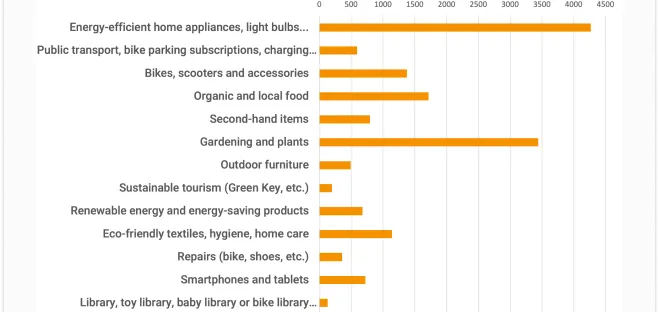
Because the eco voucher was never set in stone back in 2009. Year after year, the list of products and services it covers has grown to keep pace with the market and with changing consumer habits: energy-saving light bulbs and higher-efficiency appliances, electric bikes and scooters, public transport subscriptions, products from short supply chains or the second-hand circuit, repairing appliances rather than replacing them. As recently as 1 June 2026, the National Labour Council updated the list again. Fairtrade-labelled food, ASC-certified seafood and textile products were added, while the energy criteria for fridges, dishwashers and washer-dryers were tightened to reflect what the market can genuinely deliver today. That, in itself, is proof of a deeper consistency: year after year, the social partners keep fine-tuning the tool so it stays true to its two founding goals, purchasing power and sustainable consumption.
The numbers behind its success
That vitality shows up in the numbers too. Every year, roughly 2.3 million workers across more than 121,000 companies receive eco vouchers, worth a theoretical market value of around €575 million. But what stands out most isn’t the volume, it’s how naturally this budget has woven itself into households’ everyday lives. Forget the image of a voucher gathering dust in a drawer: one worker in four now uses their eco voucher for everyday purchases rather than saving it for one big annual splurge. The small nudge dreamt up in 2009 has, over time, become a genuine household budgeting tool: it no longer simply tops up families’ purchasing power, it’s become part of it, alongside wages or meal vouchers.
A university study confirmed by an IPSOS survey
This isn’t just a hunch; a university study already proved it scientifically back in 2022. According to Hasselt University, every €100 in eco vouchers raises the likelihood of buying a sustainable product by 32%, an effect measured on real purchasing behaviour and most pronounced among lower-income households. In late 2025, Monizze commissioned an IPSOS survey of beneficiaries themselves, which confirms and brings that finding up to date:
- 72.3% say the eco voucher genuinely steers their purchases towards more sustainable products, confirming, three years on and on the ground, the effect the 2022 study first demonstrated
- 60.7% put the value of their eco voucher at or close to the legal cap of €250, proof the tool is being used to the full to support workers’ purchasing power
- 78.1% want the scheme kept as it is, or even strengthened, support that, far from eroding, is actually growing
What’s next for the eco voucher?
It’s against this backdrop that Belgium’s federal coalition agreement flagged, in early 2025, a review of several extra-legal voucher schemes, eco vouchers included, to be carried out in consultation with the social partners.
The social partners have since delivered their opinion, and it is negative. Employers and trade unions on the National Labour Council reject both options: no conversion into net pay, and no merger with meal vouchers.
Paying eco vouchers as net pay would first create a real risk of unconstitutionality, because their special tax treatment could no longer be justified. It would also cost social security €2 billion in contributions, without reducing employers’ administrative burden. On top of that, some of this purchasing power could go abroad or into savings accounts, whereas eco vouchers are, by definition, spent entirely in Belgium.
A “single voucher” is no more convincing. It would penalise part-time workers and employees on sick or maternity leave, because the eco voucher amount doesn’t depend on working time, unlike the number of meal vouchers, which is based on days worked. It would also put more than 2,800 jobs at risk in the shops that accept eco vouchers, which generate €400 million in turnover. And it would dilute the scheme’s environmental purpose: eco vouchers help cut Belgians’ carbon footprint by 350,000 tonnes of CO₂ a year.
The final decision rests with the government, but this opinion clearly supports keeping the eco voucher. And the eco voucher itself keeps evolving in very concrete ways: a new product list, new labels and new energy criteria, in force since 1 June 2026.
Seventeen years after its creation, the eco voucher remains true to its original purpose: supporting the purchasing power of millions of Belgian workers while encouraging more sustainable consumption, an impact now confirmed by two scientific studies.